Aluminum Mesh Security Doors Exporter
Aluminum Mesh Security Doors Exporter
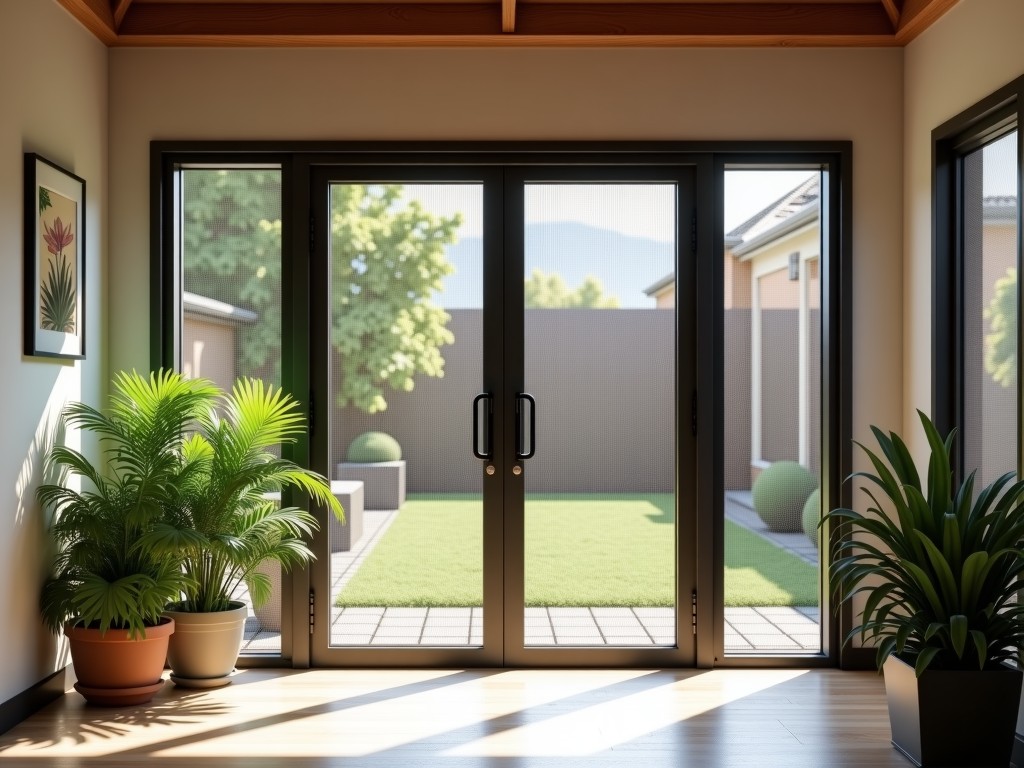
High-Performance Aluminum Mesh Security Doors for Industrial and Commercial Perimeter
Selecting a security solution requires a precise balance between structural integrity, visibility, and resistance to environmental corrosion. Unlike traditional solid steel barriers, aluminum mesh security doors utilize advanced alloys to provide a high strength-to-weight ratio, ensuring that airflow does not compromise the physical barrier. These systems are engineered for environments where visibility is critical for operational monitoring, yet protection against unauthorized entry remains non-negotiable.
Engineering Considerations: Material and Structural Integrity
The performance of a mesh door starts with the aluminum alloy selection. We typically utilize 6063-T5 or 5052 alloys, chosen for their high yield strength and excellent response to powder-coating processes. The mesh itself is often fabricated through wire-welding techniques, where the wires are fused to create a rigid grid that resists deformation under significant impact or mechanical stress.
In coastal or high-humidity environments, oxidation is the primary failure point for ferrous metals. Aluminum forms a natural protective oxide layer, which is further enhanced through industrial-grade architectural anodization or polyester powder coatings. This reduces the maintenance lifecycle significantly compared to galvanized steel, as the risk of structural rust-through is much much eliminated.
Technical Specifications and Standard Parameters
| Parameter | Standard Specification |
|---|---|
| Alloy Grade | 6063-T5 / 5052 Aluminum |
| Mesh Wire Diameter | 3.0mm to 8.0mm (Customizable) |
| Mesh Aperture | 20mmx20mm to 60mmx60mm |
| Frame Profile | 80mm to 150mm depending on load requirements |
| Surface Treatment | Anodized or Powder Coated (Min 80 microns) |
| Hardware Material | Stainless Steel 304 / 316 |
Manufacturing and Fabrication Process
The manufacturing process begins with precision CNC wire cutting to ensure dimensional consistency. The mesh panels are then subjected to robotic welding where every contact point is thermally-bonded, ensuring the entire panel acts as a single monolithic unit that cannot be cut apart with standard hand tools.
Following mesh fabrication, the frames are extruded from heavy-duty aluminum profiles. Tolerances are maintained within ±1.5mm to ensure that door hinges and locking mechanisms operate smoothly even after significant thermal fluctuations. This level of precision is vital for high-traffic industrial doors that undergo thousands of cycles per year.
Industrial Application scenarios
- Data Centers: Providing natural ventilation for high-heat server rooms while preventing physical access to hardware.
- Logistics Facilities: Securing loading bays while allowing security personnel to maintain visual contact with external operations.
- Manufacturing Plants: Protecting sensitive machinery in areas where air circulation is required for cooling process control.
- Educational Infrastructure: Offering vandal-resistant barriers for gyms and laboratories that require transparency for safety monitoring.
Customization and OEM Integration
Procurement teams often find that standard off-the-shelf dimensions fail to meet specific architectural constraints. We offer comprehensive customization including mesh aperture sizes to meet specific security ratings (e.g., smaller mesh to prevent tool insertion) and the integration of electronic locking systems, card readers, and fire-rated sensors.
For large-scale projects, we provide full technical documentation and CAD drawings to ensure the mesh door systems integrate seamlessly with existing building life safety systems. View our full product range specifications here.
Technical Inquiry
Are you requiring specific load-bearing calculations or material compatibility data for your project? Our engineering team can provide detailed specifications based on your site requirements.
Request Technical Data & Quotation