Wooden Entrance Door For Villa Factory
Wooden Entrance Door For Villa Factory
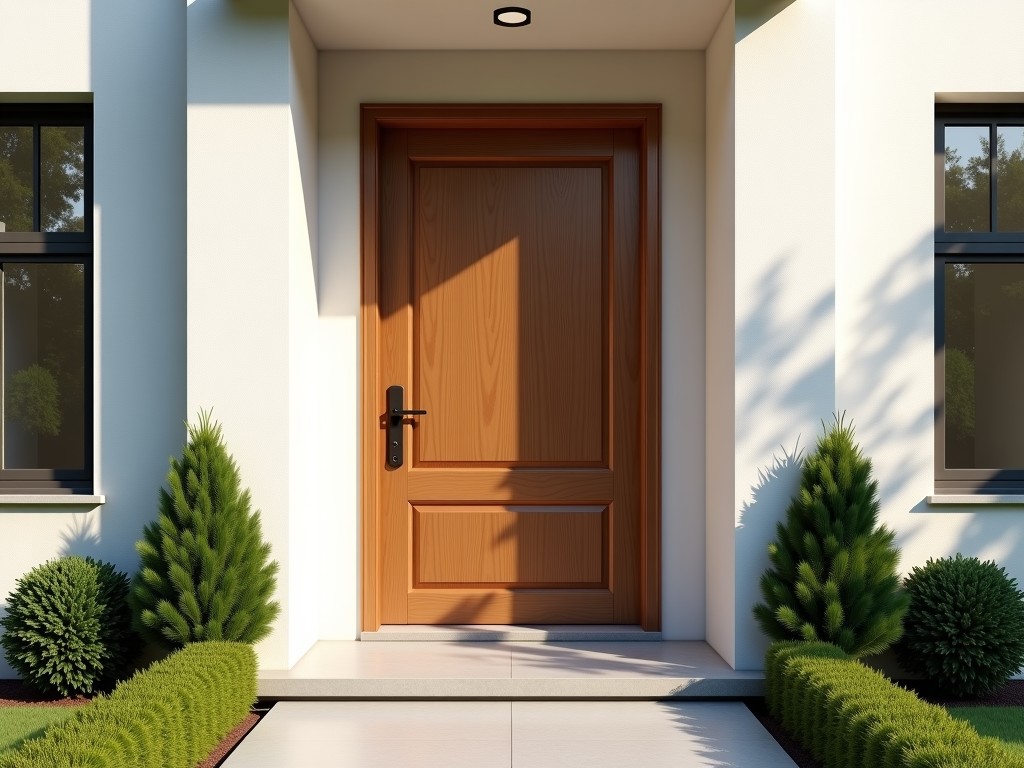
Wooden Entrance Doors for Villa Applications: Technical Considerations for Performance and Longevity
Selecting an entrance door for a villa requires balancing aesthetic expectations with functional performance under varying environmental conditions. Unlike standard residential doors, villa entrances often face greater exposure to wind, precipitation, and temperature fluctuations, necessitating careful attention to material stability, joinery integrity, and finishing systems to ensure long-term operation without warping, swelling, or degradation.
Material Selection and Dimensional Stability
The choice of timber species directly influences the door’s resistance to moisture absorption and dimensional change. Hardwoods such as European oak, sapele, or accoya-treated wood are commonly specified for their favorable strength-to-weight ratio and lower movement coefficients compared to softwoods. Accoya, for instance, undergoes acetylation to reduce hydroxyl groups in the cell wall, resulting in significantly reduced swelling and shrinkage — typically below 0.5% radial movement under cyclic humidity changes — making it suitable for climates with pronounced seasonal variation.
Core construction also plays a critical role. Solid wood panels offer traditional appeal but may be prone to twisting in wide sections. Engineered cores — such as laminated veneer lumber (LVL) or finger-jointed stiles and rails — provide enhanced straightness and resistance to cupping by balancing internal stresses. These constructions are particularly beneficial in doors exceeding 1000mm in width, where solid sections may exceed acceptable deflection limits under self-weight and wind load.
Joinery and Structural Integrity
Traditional mortise and tenon joints, when properly fitted and glued with moisture-resistant adhesives (e.g., polyurethane or epoxy-based systems), provide mechanical strength that accommodates seasonal wood movement without joint failure. Modern alternatives include dowelled or biscuit-reinforced joints combined with floating panel systems, which allow for expansion and contraction across the grain while maintaining frame rigidity. The stile and rail assembly must accommodate expected movement — typically 1–2mm per meter of width per 10% RH change — to avoid joint cracking or panel binding.
For doors incorporating glazing, bead systems must allow for lateral and vertical movement of the glass unit to prevent stress cracking. Flexible glazing gaskets (EPDM or silicone) combined with compression-limited beads ensure the insulating glass unit (IGU) remains isolated from frame distortions, preserving seal integrity and thermal performance over time.
Finishing Systems and Surface Protection
The finish is not merely cosmetic — it is the primary defense against moisture ingress, UV degradation, and surface checking. Micro-porous finishes (e.g., water-based acrylics or modified alkyds) allow moisture vapor transmission while blocking liquid water, reducing the risk of blistering or peeling common with film-forming coatings. Pigmented stains offer UV protection by absorbing harmful radiation, while clear finishes require regular maintenance to prevent graying and surface erosion.
Factory-applied finishes typically achieve better film uniformity and edge coverage than field applications, particularly critical for end-grain surfaces which absorb finish at higher rates. Edge sealing — often overlooked — is essential to prevent capillary uptake that can lead to internal swelling undetectable from the surface. A minimum of 3–4 coats, with proper sanding between layers, is generally recommended for exterior exposure in temperate to humid climates.
Typical Specifications and Performance Parameters
| Parameter | Typical Range / Specification | Relevance to Performance |
|---|---|---|
| Door Thickness | 40–56 mm | Influences stiffness, thermal resistance, and hardware compatibility |
| Width (Single Leaf) | 800–1200 mm | Widths >1000mm often require engineered stiles or mid-rails to limit deflection |
| Height | 2000–2500 mm | Taller doors increase leverage on hinges; may require anti-sag hardware or additional hinges |
| Glazing Option | Single, double, or triple IGU; low-E coatings available | Affects U-value, solar gain, and condensation resistance; must align with frame thermal break |
| Finish System | Micro-porous stain or paint; 3–4 coats factory-applied | Determines maintenance cycle and resistance to surface checking |
| Movement Accommodation | Floating panels; compression-limited glazing beads | Prevents joint stress and glass cracking due to hygroscopic movement |
Customization and Manufacturing Considerations
Villa entrance doors frequently require non-standard dimensions, unique panel configurations, or integrated hardware such as multi-point locking systems, concealed hinges, or access control accommodations. Customization begins with detailed drawings or BIM models that specify tolerances, reveal depths, and hardware preparations. Lead times for custom units typically range from 4–8 weeks after drawing approval, depending on material availability and finish complexity.
Minimum order quantities for custom runs are often flexible — single units are commonly produced for architectural projects — though material sourcing may impose practical minimums for specialty species or pre-finished components. Packaging for export includes corner protection, edge guards, and moisture-barrier wrapping to prevent finish damage and moisture uptake during transit, particularly important for long-haul or high-humidity shipping routes.
Installation and Long-Term Maintenance
Proper installation is critical to performance. The frame must be plumb, square, and securely anchored to the opening with adequate shimming to transfer loads without inducing twist. A minimum 10–15mm clearance around the perimeter allows for foam insulation and accommodates minor structural movement. Threshold design should prevent water pooling while maintaining accessibility — sloped or recessed thresholds with drainage channels are preferred in exposed locations.
Maintenance intervals depend on finish type, exposure, and climate. In moderate climates, a well-applied micro-porous finish may require inspection every 12–18 months, with recoating only when water no longer beads on the surface or UV degradation is evident. Hinges and locks should be lubricated annually, and weather seals checked for compression set or cracking. Doors in coastal or high-UV environments may benefit from more frequent monitoring and touch-up recoating of vulnerable areas such as sill edges and top rails.
Discuss your project requirements with our engineering team to review material options, dimensional constraints, and finishing systems suited to your villa’s location and design intent.