Top Aluminum Louvered Security Doors
Top Aluminum Louvered Security Doors
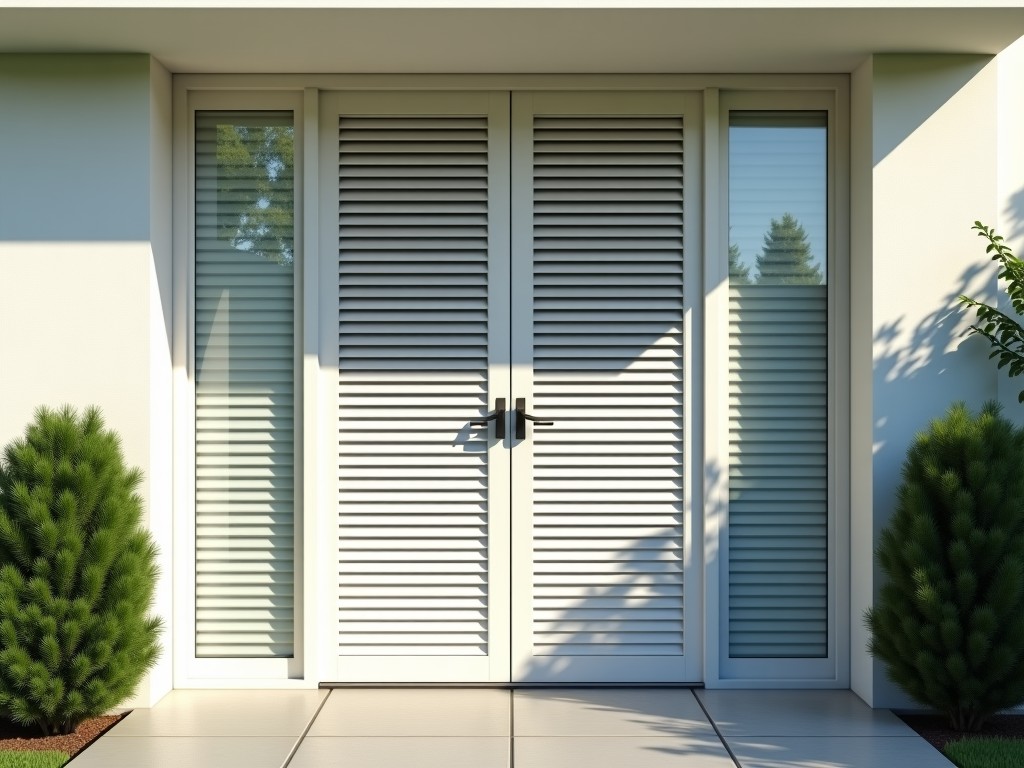
High-Performance Aluminum Louvered Security Doors for Industrial Ventilation and Protection
In industrial environments where equipment cooling is critical, balancing ventilation with physical security presents a significant engineering challenge. Aluminum louvered security doors are engineered to resolve this conflict by providing a robust barrier against unauthorized access while maintaining continuous airflow for mechanical equipment rooms. Unlike solid steel doors that trap heat and moisture, these systems utilize high-grade aluminum alloys that offer superior strength-to-weight ratios, ensuring structural integrity even under high-duty operational cycles.
Engineering Considerations for Material Selection
The selection of aluminum alloy and temper depends on the environmental exposure and mechanical load-bearing requirements. We typically utilize 6063-T5 or 6061-T6 alloys for their extrudability and resistance to corrosion. For coastal installations or high-humidity facilities, the surface treatment—typically architectural-grade powder coating or clear anodization—is mandatory to prevent galvanic corrosion and ensure the longevity of the louver blade assembly.
- Thermal Stability: Aluminum's coefficient expansion coefficient is accounted for in frame design to prevent binding in environments with extreme temperature fluctuations.
- Airflow Dynamics: The louver geometry is calculated to optimize free area percentage, minimizing pressure drop and ensuring HVAC systems operate within their design parameters.
- Structural Integrity: Heavy-gauge hollow section profiles provide the necessary rigidity to resist impact without the deflection seen in thinner-gauge alternatives.
Technical Specifications and Performance Data
| Parameter | Standard Industrial Specification |
|---|---|
| Material Composition | Aluminum Alloy 6063-T5 / 6061-T6 |
| Frame Thickness | 2.0mm to 5.0mm (Custom per load) |
| Louver Type | Fixed, Adjustable, or Gravity-Operated Louvers |
| Free Area Percentage | 40% to 75% (Depending on blade profile) |
| Hardware Finish | Stainless Steel 304/316 Grade |
| Surface Treatment | Anodized or Powder Coated (ASTM) |
Manufacturing Process and Quality Control
Our production workflow begins with precision extrusion to ensure tight dimensional tolerances within ±0.5mm. This precision is vital for the seamless operation of the louver blades and the alignment of the door frames. We use CNC-machined components for hinge points and locking mechanisms to ensure that the security rating remains consistent over thousands of cycles.
Every unit undergoes a rigorous inspection process where we verify frame flatness to prevent binding and the adhesion strength of the surface finish. For high-security applications, we can perform load testing on sample frames to ensure they meet the specific impact resistance requirements of the facility.
Industrial Application Scenarios
These doors are deployed in environments where both airflow and protection are non-negotiable. Common installations include:
Data Centers
Protecting server infrastructure while allowing necessary heat exhaust to prevent thermal throttling.
Mechanical Rooms
Securing HVAC units and chiller plants while preventing debris ingress and unauthorized entry.
Industrial Plants
Providing ventilation for chemical storage or manufacturing zones where corrosion resistance is vital.
Customization and OEM Services
We recognize that standard dimensions rarely fit every complex architectural project. We offer comprehensive customization, including custom louver blade angles to meet specific airflow requirements, integrated mesh for pest control, and specialized locking hardware. Our team works directly with design engineers to provide technical drawings that integrate seamlessly into existing building envelope systems.
Ready to discuss your technical specifications or project requirements?
Request Technical Data Sheet & QuoteFrequently Asked Questions
How do aluminum louvered doors compare to steel in salt-air environments?
Aluminum naturally forms a protective oxide layer that resists rust, whereas steel requires frequent maintenance or high-cost galvanization to prevent structural failure due to corrosion in coastal zones.
Can the free area be adjusted for specific HVAC loads?
The free area is determined by the blade profile and spacing. We can customize the blade geometry to achieve the specific airflow volume required by your mechanical engineers.
What is the typical lead time for custom-sized orders?
Lead times vary based on complexity of the extrusion and surface coating requirements. We provide a detailed schedule upon review of your project drawings.