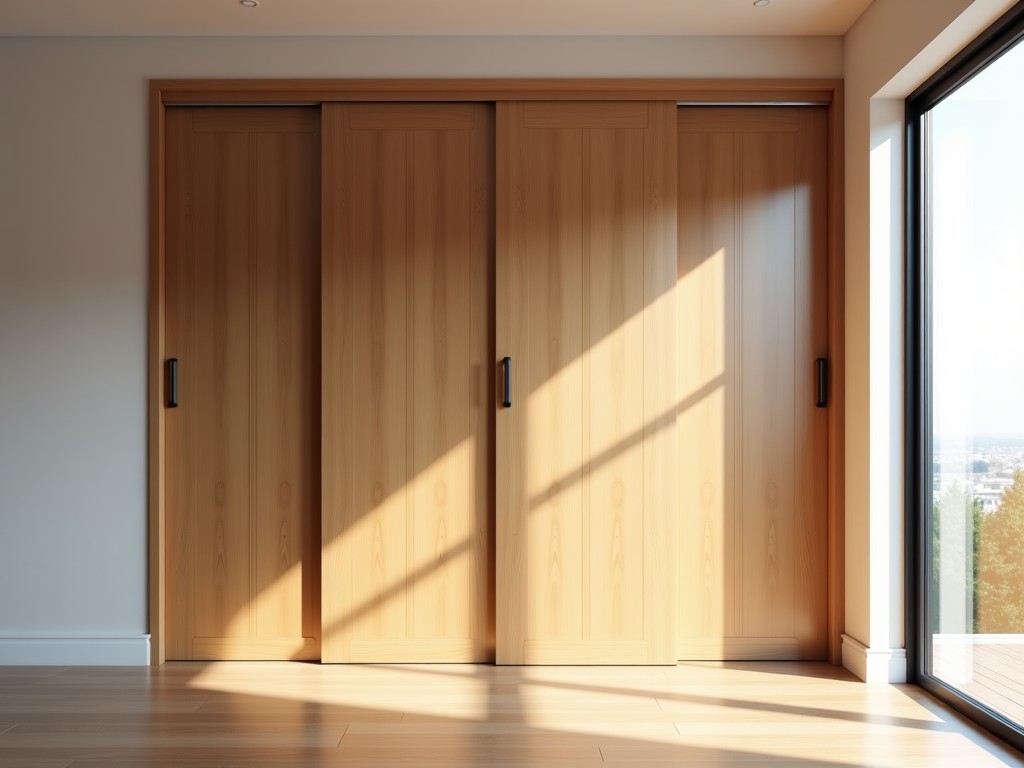
Cheap Sound Insulation Wooden Door
Cheap Sound Insulation Wooden Door

Sound Insulation Wooden Door for Industrial Facilities
In environments where noise control impacts operational efficiency and worker safety, standard interior doors often fail to provide adequate acoustic separation. Sound transmission through door assemblies can compromise concentration in control rooms, disrupt testing procedures in laboratories, and violate workplace noise regulations in manufacturing plants. Addressing this requires a door solution engineered specifically for acoustic performance without sacrificing the durability needed in industrial settings.
Engineering Approach to Acoustic Performance
Effective sound insulation in wooden doors relies on mass, damping, and decoupling principles rather than material thickness alone. The core construction combines multiple layers of high-density wood-based materials with viscoelastic damping compounds and perimeter sealing systems to disrupt sound wave transmission across frequencies. Unlike hollow-core or single-layer doors, this assembly targets both airborne and structure-borne noise by increasing surface mass while minimizing resonant transmission paths through careful layer bonding and edge treatment.
Material Selection and Core Construction
The door slab typically uses a composite core of particleboard or MDF with density ranging from 650 to 800 kg/m³, selected for its uniform internal structure and consistent acoustic damping properties. Facings are bonded with phenol-formaldehyde or melamine-urea-formaldehyde adhesives to ensure long-term stability under varying humidity conditions common in industrial facilities. The perimeter incorporates a multi-durometer sealing system — combining a rigid vinyl fin for alignment and a flexible silicone bulb for compression — to maintain acoustic integrity over thousands of cycles.
Manufacturing Process and Quality Control
Production begins with precision cutting of core materials to tolerances within ±0.5 mm, followed by adhesive application under controlled pressure and temperature to eliminate voids that could create sound leaks. Each slab undergoes edge sealing with acoustic-grade compound before facing lamination. Final assembly includes hinge reinforcement with steel plates mortised into the core to prevent sagging that could compromise seal compression. Quality verification involves dimensional inspection, adhesion testing, and preliminary acoustic screening using tapping methods to detect delamination or voids before final sealing.
Typical Performance Characteristics
Sound reduction performance is measured in laboratory conditions according to ISO 10140-2, with results expressed as weighted sound reduction index (Rw). Actual field performance depends on frame installation, sealing continuity, and surrounding wall construction. The following table outlines typical achievable values based on core thickness and facing configuration:
| Configuration | Core Thickness (mm) | Typical Rw (dB) | Effective Frequency Range |
|---|---|---|---|
| Standard Particleboard Core | 40 | 30–32 | 500–3150 Hz |
| High-Density MDF Core | 40 | 33–35 | 500–3150 Hz |
| Damped Composite Core | 50 | 36–38 | 250–4000 Hz |
| Double-Layer with Air Gap | 50 + 50 | 40–42 | 125–5000 Hz |
Application-Specific Considerations
In audiometric testing enclosures, doors must maintain sealing integrity under repeated use while minimizing low-frequency transmission that could interfere with baseline measurements. For machine control rooms, mid-frequency attenuation (500–2000 Hz) is prioritized to mask motor and gear noise without excessive weight that hinders emergency egress. Cleanroom installations require non-particle-emitting edges and seal materials that withstand IPA cleaning without degradation. Each application influences core density, facing finish, and seal compression force specifications.
Customization and Integration Options
Beyond standard configurations, the door assembly can be adapted to project-specific requirements. Vision panels use laminated acoustic glass with butyl spacers to maintain STC ratings while allowing visibility. Hardware preparations include reinforced mortises for panic bars, door closers, and access control systems, with load distribution calculated to prevent core deformation. Veneer finishes are available in industrial-grade melamine, HPL, or real wood species, selected for abrasion resistance and stability in high-traffic zones. All customizations undergo acoustic revalidation to ensure performance targets are not compromised by modifications.
Packaging, Logistics and Installation
Doors are packaged individually in polyethylene wraps with corner protectors and placed on horizontal skids to prevent warping during transit. Each unit includes a factory-set jamb and pre-machined strike plate for alignment consistency. Installation guidance emphasizes shimming the frame to plane tolerance within 1.5 mm and applying continuous acoustic sealant between frame and substrate — steps critical to achieving laboratory-rated performance in field conditions. Lead times vary based on core material availability and finish complexity, typically ranging from 3 to 6 weeks for standard configurations.
Selection Criteria for Procurement and Engineering Teams
When evaluating acoustic doors, request third-party test reports specifying the test standard, mounting conditions, and frequency-by-frequency performance rather than relying solely on single-number ratings. Verify that seal compression force falls within the range that ensures longevity (typically 5–15 N/mm) without preventing manual operation. Consider the lifecycle cost implications of seal replacement frequency and core resistance to edge chipping in high-impact areas. For OEM projects, early collaboration allows integration of acoustic requirements into frame design, avoiding costly retrofits.
Discuss your project’s acoustic and operational requirements with our engineering team to determine the optimal door configuration.
Share your specifications, including opening dimensions, target noise reduction, and environmental conditions, for a tailored proposal and lead time confirmation.