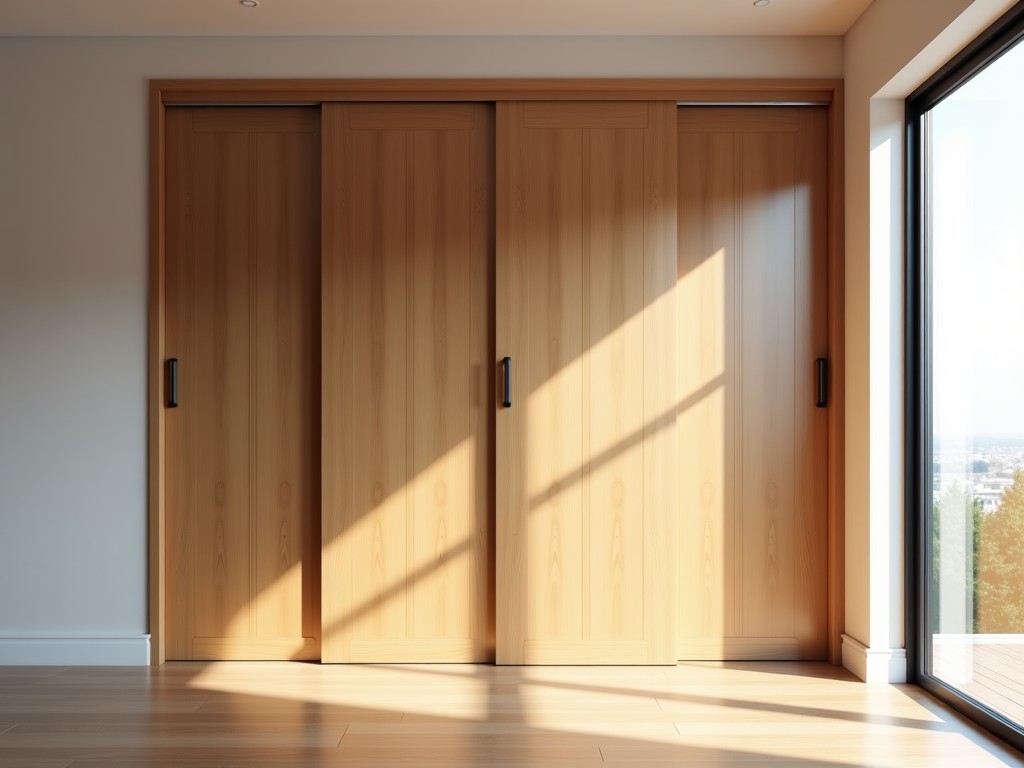
China Solid Core Flush Door
China Solid Core Flush Door

Solid Core Flush Door: Engineering Overview for Industrial and Commercial Applications
In facilities where door performance impacts safety, acoustics, and long-term operational continuity, the specification of solid core flush doors requires careful evaluation beyond surface appearance. Unlike hollow core alternatives, solid core constructions provide measurable benefits in fire resistance, sound attenuation, and structural stability—critical factors in healthcare, education, corrections, and high-traffic commercial environments. This page outlines the technical characteristics, material considerations, and performance attributes that inform procurement and design decisions for solid core flush doors in demanding applications.
Material Composition and Core Construction
The term "solid core" refers to the internal structure of the door slab, which is engineered to deliver consistent density and mechanical properties across the entire panel. Common core materials include particleboard, medium-density fiberboard (MDF), and composite agrifiber products, each selected based on target performance criteria such as screw holding strength, flame spread rating, and dimensional stability under varying humidity conditions. Particleboard cores, typically manufactured from wood residues bonded with urea-formaldehyde or melamine-urea-formaldehyde resins, offer a cost-effective balance of density and machinability. MDF cores provide superior surface uniformity and edge integrity, reducing the risk of telegraphing through veneers or laminates. Agrifiber cores, derived from agricultural byproducts, are increasingly specified in projects emphasizing sustainable material sourcing while maintaining comparable physical properties to wood-based alternatives.
Core density generally ranges from 400 to 650 kg/m³, depending on the material and manufacturing process. Higher density correlates with improved sound transmission class (STC) ratings and enhanced resistance to impact and concentrated loads. The core is bonded to face veneers or laminate skins using industrial adhesives designed for long-term durability under cyclic loading and environmental exposure. Face materials may include hardwood veneers, decorative laminates, or paint-grade surfaces, each selected based on aesthetic requirements and maintenance protocols.
Performance Characteristics and Testing Standards
Solid core flush doors are frequently evaluated against recognized industry standards to verify performance in fire, acoustics, and durability. Fire-rated assemblies are tested in accordance with NFPA 252 (Standard Methods of Fire Tests of Door Assemblies) or UL 10C, with ratings typically ranging from 20 to 90 minutes based on core thickness, edge sealing, and frame compatibility. Acoustic performance is measured using ASTM E90 and ASTM E413, where STC values for solid core doors commonly fall between 30 and 35, significantly outperforming hollow core equivalents (typically STC 20–25). These values are influenced by core density, perimeter sealing, and the mass-law principle, which states that sound transmission loss increases with panel mass per unit area.
Durability is assessed through cyclic operation testing (e.g., ANSI A250.4), where doors are subjected to hundreds of thousands of open-close cycles to evaluate hinge retention, surface integrity, and resistance to warping. Edge construction—whether solid lumber, MDF, or composite—plays a critical role in preventing delamination and maintaining alignment over time. Properly specified solid core doors demonstrate minimal creep and dimensional change under sustained load, making them suitable for applications involving automatic operators, panic hardware, or frequent use.
Manufacturing Process and Quality Control
Production begins with the formation of the core panel, typically via hot pressing of resin-bonded fibers or particles under controlled temperature and pressure to achieve uniform density and thickness tolerance. The core is then cut to precise dimensions, followed by the application of face skins using cold or hot press bonding with adhesives selected for compatibility with both substrate and face material. Edge banding is applied using extrusion or hot melt techniques to seal exposed surfaces and enhance moisture resistance.
Quality control procedures include density sampling, thickness variation checks (typically within ±0.5 mm), adhesive bond strength testing via peel or shear methods, and surface finish inspection for defects such as telegraphing, blistering, or uneven gloss. Finished doors are often conditioned in climate-controlled environments prior to packaging to stabilize moisture content and reduce the risk of post-installation warping. Packaging methods vary by destination but generally include edge protection, corner guards, and moisture-barrier wrapping to safeguard against damage during transit and storage.
Typical Specifications and Customization Options
| Specification | Typical Range / Options |
|---|---|
| Core Material | Particleboard, MDF, Agrifiber |
| Core Density | 400–650 kg/m³ |
| Thickness | 35 mm, 40 mm, 44 mm, 50 mm |
| Face Options | Hardwood veneer, decorative laminate, paint-grade |
| Fire Rating | 20, 45, 60, 90 min (dependent on assembly) |
| STC Rating | 30–35 (typical for solid core) |
| Custom Sizes | Available upon request |
| Edge Treatment | Solid wood, MDF, PVC, or composite banding |
Customization extends beyond dimensions to include specialized edge profiles, pre-machining for hardware (hinges, locks, strikes), and factory-applied finishes to reduce field labor. Lead times vary based on material availability, complexity of machining, and order volume, but standard configurations typically ship within 2–4 weeks. For projects requiring precise alignment with fire-rated frames or acoustic seals, early coordination with the manufacturer ensures compatibility and reduces field modification risks.
Application Scenarios and Industry Use
In healthcare facilities, solid core flush doors are specified in patient corridors, examination rooms, and sterile supply areas where acoustic privacy and infection control surfaces are essential. The mass and damping characteristics of the core contribute to reduced sound transmission between adjacent spaces, supporting patient rest and confidential consultations. In educational institutions, these doors withstand high traffic and frequent abuse, with resistance to denting and surface damage exceeding that of hollow core alternatives. Their compatibility with panic hardware and electronic access control systems makes them suitable for egress doors in auditoriums, gymnasiums, and classroom wings.
Correctional and detention facilities utilize solid core doors in cell walls, day rooms, and security vestibules due to their enhanced resistance to forced entry and ability to maintain integrity under sustained load. When paired with appropriate frames and hardware, they meet behavioral health and security standards requiring ligature-resistant and anti-barricade features. Commercial offices and hospitality venues benefit from the doors’ dimensional stability in environments with fluctuating HVAC cycling, reducing the likelihood of binding or gaps that compromise acoustics and energy efficiency.
For OEMs and distributors, understanding the relationship between core material, density, and end-use performance enables accurate specification matching and reduces the risk of field failures. Procurement teams evaluating long-term value consider not only initial cost but also lifecycle factors such as maintenance frequency, replacement interval, and compatibility with future hardware upgrades.
Selection Considerations and Procurement Guidance
When evaluating solid core flush doors, procurement teams should verify core composition and density specifications, as these directly influence acoustic and fire performance. Requesting test reports from accredited laboratories (e.g., for STC, fire rating, or cyclic operation) provides objective data for comparison across suppliers. Edge construction details are particularly important in high-moisture or high-impact environments, where inadequate sealing can lead to swelling or delamination over time.
Lead time, packaging standards, and the availability of pre-machining services should be confirmed early in the procurement process to align with project schedules and labor planning. For customized orders, providing detailed drawings or schedules ensures accurate quoting and minimizes the risk of manufacturing errors. Samples or mockups may be requested to validate surface finish, edge quality, and weight prior to full production release.