Natural Wood Door Industrial Applications Manufacturer
Natural Wood Door Industrial Applications Manufacturer
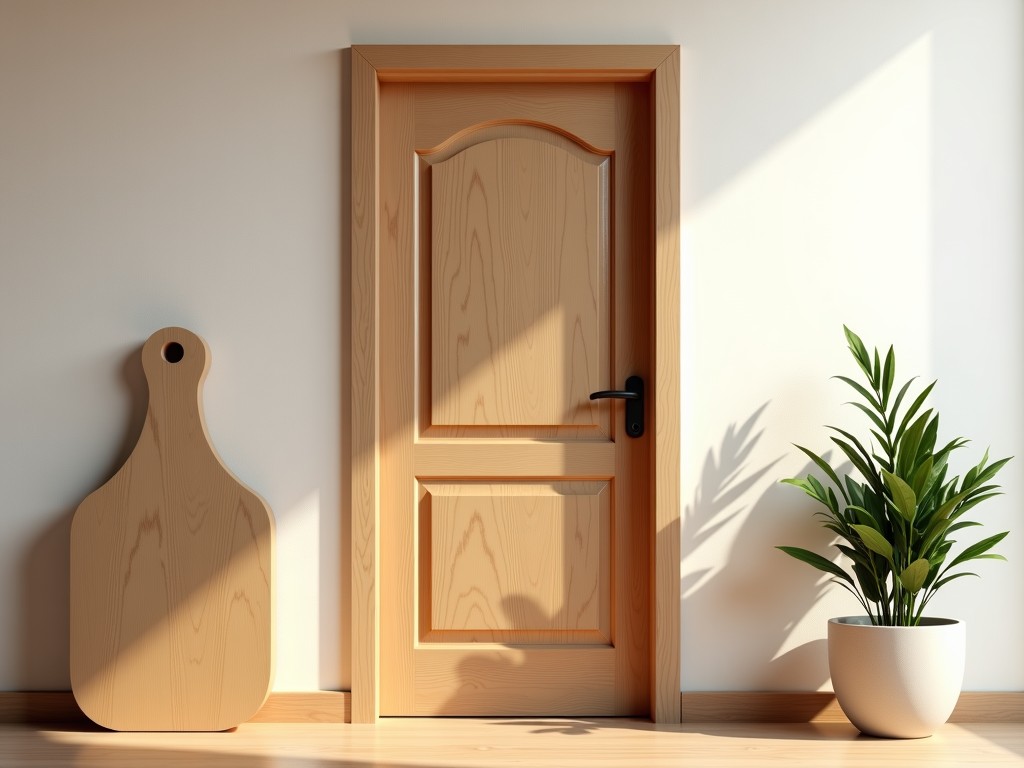
Natural Wood Door – Engineered for Architectural and Industrial Applications
When selecting doors for commercial, institutional, or light industrial facilities, material stability, dimensional accuracy, and surface integrity directly impact long-term performance and lifecycle cost. Natural wood doors remain a preferred solution where aesthetic integration, acoustic properties, and moderate structural demands align with project requirements. This page outlines the engineering considerations, material behaviors, and manufacturing practices that determine suitability for specific applications.
Material Selection and Stability Characteristics
The performance of a natural wood door begins with species selection and moisture content control. Commonly used hardwoods such as oak, maple, and walnut offer varying densities (typically 600–800 kg/m³) and grain structures that influence resistance to warping, swelling, and surface checking. Softwoods like pine or fir are selected for lower weight and cost but require tighter environmental controls due to higher movement coefficients. Kiln drying to 8–12% equilibrium moisture content (EMC) is standard practice to minimize dimensional change post-installation, particularly in HVAC-regulated environments.
Manufacturing Process and Dimensional Control
Panel construction typically employs stave-laminated cores or engineered lumber substrates to reduce internal stress and improve flatness. Face veneers are rotary-cut or sliced and bonded using urea-formaldehyde or phenolic adhesives depending on environmental exposure ratings. Door stiles and rails are often finger-jointed for length stability and machined to tight tolerances (±0.5 mm on thickness, ±1.0 mm on width and height) to ensure consistent fit within frames. CNC milling ensures precise routing for hardware prep, glazing beads, and panel raises, reducing reliance on manual fitting during installation.
Performance Advantages in Specific Environments
Natural wood provides inherent thermal resistance (R-value approximately 0.8–1.2 per inch depending on density) and sound dampening properties, making it suitable for office partitions, conference rooms, and healthcare corridors where noise reduction is a design criterion. Unlike metal or plastic alternatives, wood does not conduct cold or create condensation bridges in temperature-variant zones. When finished with sealed coatings (e.g., UV-cured polyurethane or water-based lacquer), surface durability increases, reducing maintenance frequency in high-traffic zones.
Typical Specifications
| Parameter | Typical Range / Value | Notes |
|---|---|---|
| Door Thickness | 35–45 mm | Standard for interior applications; exterior may require 50+ mm |
| Width (Single Leaf) | 600–900 mm | Custom widths available; double leaves for openings >1200 mm |
| Height | 1900–2400 mm | Standard heights; custom upon request |
| Face Veneer Thickness | 0.6–1.2 mm | Thicker veneers allow for sanding/refinishing cycles |
| Core Construction | Stave-laminated, particleboard, or MDF | Selected based on load, moisture exposure, and cost |
| Finish Options | Clear coat, stain, paint, or lacquer | Specified per project aesthetic and durability needs |
| Fire Rating | Available up to 60 minutes (with core treatment) | Requires certified components and labeling |
Customization and OEM Considerations
Beyond standard configurations, natural wood doors can be adapted to project-specific needs through core material substitution, edge banding, lite frames, and hardware reinforcement. For OEM integration, door blanks are supplied pre-machined for hinges, locks, and closers according to provided templates or CAD files. Custom veneer matching, stile/wide rail proportions, and non-rectangular geometries (e.g., arched tops) are feasible with increased tooling lead times. Minimum order quantities for customized runs typically start at 20–50 units depending on complexity.
Packaging, Logistics, and Handling
To prevent moisture absorption and edge damage during transit, doors are packaged individually in polyethylene wrap with corner protectors and stacked on pallets with intermediate slip sheets. Units are secured with horizontal and vertical strapping to minimize shifting. For export shipments, ISPM-15 compliant pallets and desiccant packs are available upon request. Storage prior to installation should occur in conditioned spaces (50–70% RH, 18–25°C) to maintain EMC stability.
Quality Control and Inspection
Each production batch undergoes inline checks for dimensional accuracy, adhesive bond integrity (via delamination testing), and surface finish uniformity. Final inspection includes gap measurement around the perimeter, diagonal comparison for twist (<2 mm="" tolerance="">
Share your drawings or specifications for a customized proposal